The Data Scientist
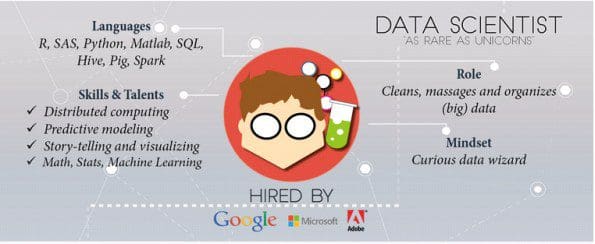
A data scientist is probably one of the hottest job titles that you can put on your business card, and the closer you get to Silicon Valley, the more valuable this role becomes. A data scientist is as rare as a unicorn and gets to work everyday with the mindset of a curious data wizard. He/she masters a whole range of skills and talents going from being able to handle the raw data, analyzing that data with the help of statistical techniques, to sharing his/her insights with his peers in a compelling way. No wonder these profiles are highly wanted by companies like Google and Microsoft.
The Data Analyst
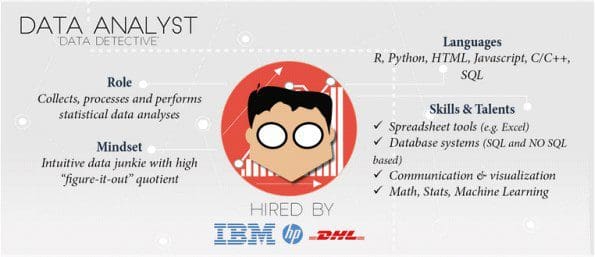
The data analyst is the Sherlock Holmes of the data science team. Languages like R, Python, SQL and C are elementary to him/her. Just like the data scientist, the skills and talents that are needed for this role are diverse and range the entire spectrum of the data science process combined with a healthy “figure-it-out” attitude. Data analysts are wanted by companies like HP and IBM (where they can be teamed up with Watson).
The Data Architect
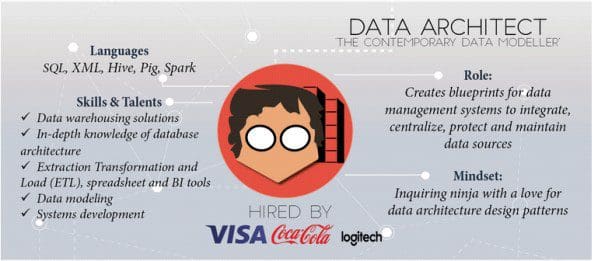
With the rise of big data, the importance of the data architect’s job is rapidly increasing. The person in this role creates the blueprints for data management systems to integrate, centralize, protect and maintain the data sources. The data architect masters technologies like Hive, Pig and Spark, and needs to be on top of every new innovation in the industry.
The Data Engineer
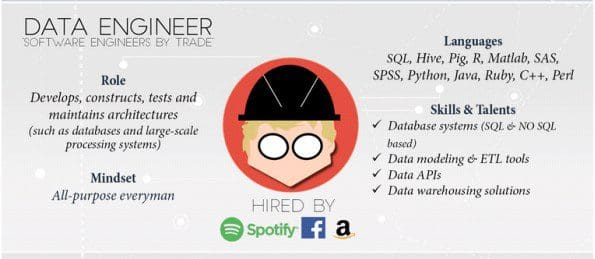
The data engineer often has a background in software engineering and loves to play around with databases and large –scale processing systems. Thanks to these interests, he/she can easily master technologies and is therefore familiar with a diverse set of languages that span both statistical programing languages and languages oriented more towards web development. Your data engineer is your jack of all trades.
The Statistician
Ah the statistician! The historical leader of data and its insights. Although often forgotten or replaced by fancier sounding job titles, the statistician represents what the data science field stands for: getting useful insights from data. With his/her strong background in statistical theories and methodologies, and a logical and stats oriented mindset, he/she harvests the data and turns it into information and knowledge. Statisticians can handle all sorts of data. What’s more, thanks to their quantitative background, modern statisticians are often able to quickly master new technologies and use these to boost their intellectual capacities. A statistician brings the mathemagic to the table, and his/her insights are able to radically transform businesses.

The Database Administrator
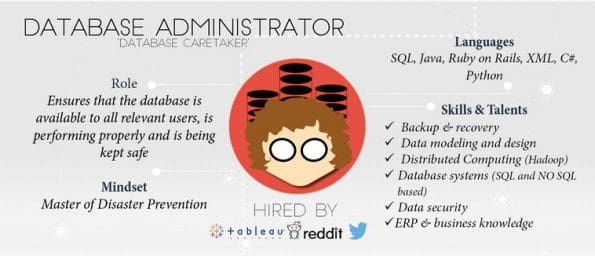
People often say that data is the new gold. This means you need someone who exploits that valuable mine. Enter the Database Administrator. Your DA makes sure that the database is available to all relevant users, is performing properly and is being kept save. Thinking how to prevent disasters comes natural to him/her. A DA makes sure that all backup and recovery systems are in place, that security is taken care of, and keeps track of the different technologies that are being used and how to support these.
The Business Analyst
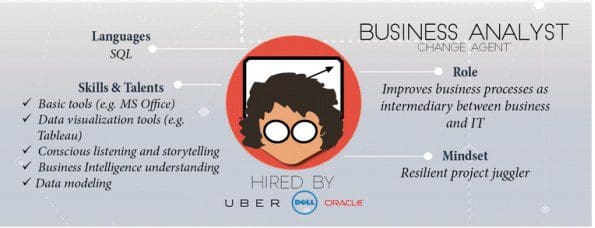
The business analyst is often a bit different from the rest of the team. While often less technically oriented, the business analyst makes up for it with his/her deep knowledge of the different business processes. (S)he masters the skill of linking data insights to actionable business insights and is able to use storytelling techniques to spread the message across the entire organization. They often act as the intermediary between the business guys and the techies. Companies looking for business analysts are diverse and active in very different industries. Some examples are Uber, Dell and Oracle.
Data and Analytics Manager
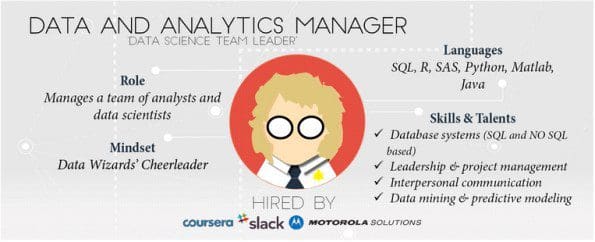
The cheerleader of the team. A data analytics manager steers the direction of the data science team and makes sure the right priorities are set. This person combines strong technical skills in a diverse set of technologies (SQL, R, SAS, …) with the social skills required to manage a team. It’s a hard job but if you feel that its fit for you, make sure to have a look at the job offerings at Coursera, Slack, or Motorola.
The Salary
To end, we had a quick look at the average salaries displayed for each roles. Note that these salaries can highly differ based on location, industry, etc. In general, it looks like a job as a data and analytics manager or a data scientists will give you the highest paycheck. This was to be expected, given the latter’s unicorn status and the former’s team lead responsibility.
In the middle we find the roles of data engineer and data architect. People with a software engineering background or a combination of software engineering and data analytics skills often fill in these roles. The recruiting competition with the jobs that are more oriented towards software development probably drives up their national average salaries.
The remaining jobs are all closely together in terms of remuneration. However, it is not unlikely the assume their wages will go up on the scale very soon, since these roles are currently increasing in demand.

Closing remarks
While the above is just an interpretation of what we observed while looking at different data science job postings, we do shed some light on the different data science jobs that are available in today’s market. While looking for your data science dream job, however, take into account that roles can differ: that is why you should make sure to ask about details on what projects and technologies you’ll be working with to make sure there is a fit for you and your skills. In the meantime, don’t forget to keep your data science skills up to date.